One of the most common questions business owners ask is:
“How much should I be paying for SEO?”
The honest answer is:
It depends.
The size of your business, the competitiveness of your industry, your geographic market, and your growth goals all play a role in determining the cost of SEO.
But while SEO isn’t cheap, it’s important to understand what you’re paying for—and what red flags to watch out for.
The Cheapest SEO Is Often the Most Expensive
If you’ve ever received SEO proposals, you’ve probably seen everything from $200/month packages to multi-thousand-dollar retainers.
The problem is that many business owners don’t know how to compare them.
As a result, some companies end up paying for SEO that produces little to no measurable value.
Others overpay for services that could be delivered far more efficiently.
The goal shouldn’t be to find the cheapest provider.
The goal should be to find the best return on investment.
The Truth About SEO Audits
One of the first things many SEO agencies sell is an SEO audit.
There’s nothing wrong with that.
A proper audit can uncover technical issues, content gaps, keyword opportunities, competitive weaknesses, and growth opportunities.
However, business owners should understand what goes into that process.
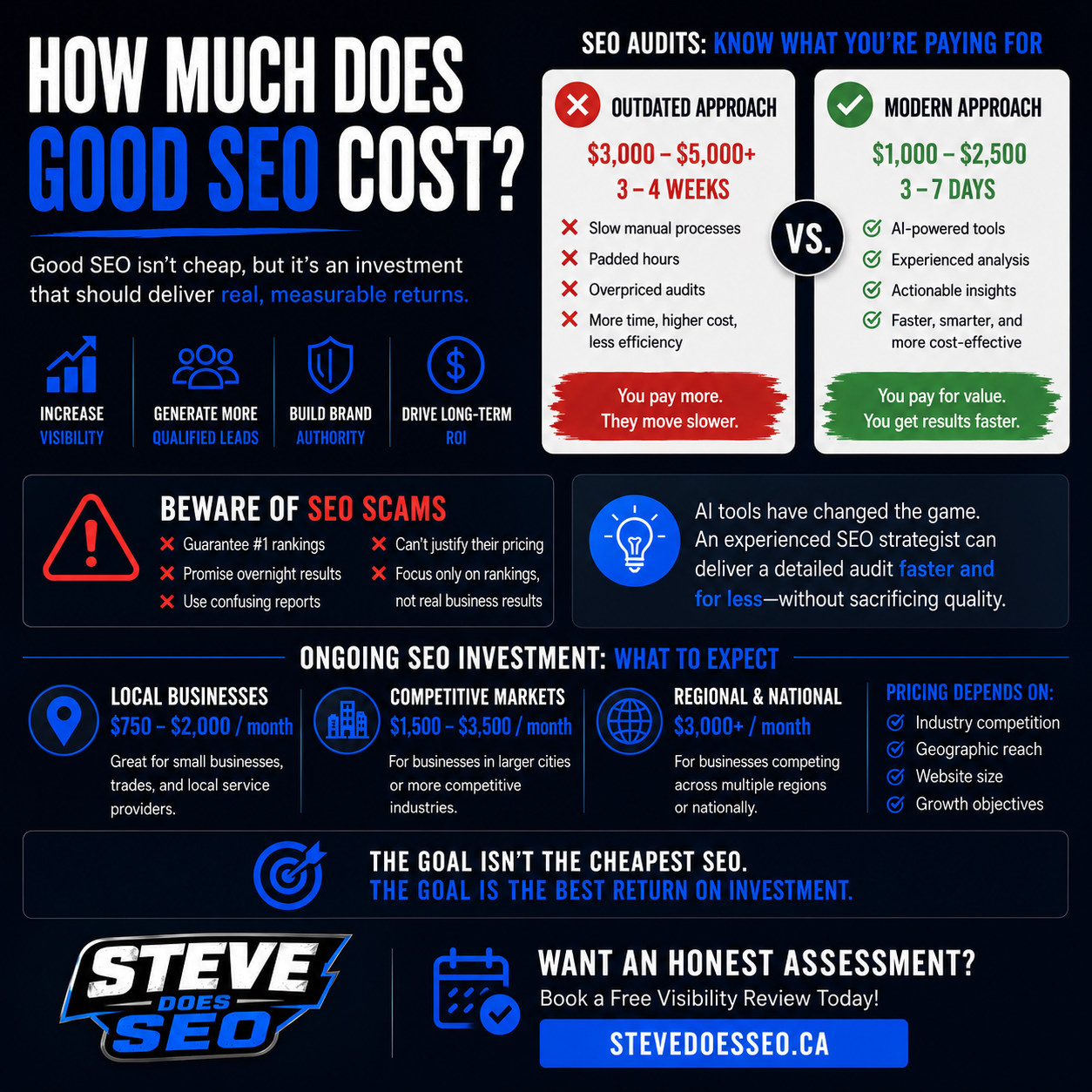
I’ve seen agencies charge $3,000 to $5,000 or more for an SEO audit and tell clients it will take three to four weeks to complete.
In some cases, that may be justified.
Large ecommerce websites, enterprise organizations, and complex websites can require extensive analysis.
But for many small and medium-sized businesses, modern SEO tools and AI-assisted analysis have dramatically reduced the amount of manual work required.
An experienced SEO strategist should often be able to:
- Analyze your website
- Review competitors
- Identify technical issues
- Evaluate content opportunities
- Assess local visibility
- Create actionable recommendations
within a matter of days—not weeks.
The real value isn’t how long someone spends producing an audit.
The real value is the quality of the insights and recommendations they provide.
AI Has Changed the Game
Artificial intelligence has transformed many aspects of SEO.
Tasks that once required hours of manual review can now be completed significantly faster.
This doesn’t mean SEO experts have become less valuable.
It means experienced professionals can spend less time gathering data and more time interpreting it.
A business owner shouldn’t be paying thousands of dollars simply because someone chooses to perform tasks manually that modern tools can accomplish more efficiently.
The value comes from expertise, strategy, and decision-making—not from artificially inflated hours.
What Should Ongoing SEO Cost?
The answer depends on your situation.
A small local business targeting a limited geographic area will typically require a different level of investment than a company competing nationally.
Factors that influence SEO pricing include:
Industry Competition
Ranking a local plumber’s website is different from competing in highly competitive legal, financial, or medical industries.
Geographic Reach
Local SEO campaigns generally require less investment than regional or national campaigns.
Website Size
A 10-page website requires a different strategy than a 500-page website.
Growth Objectives
Businesses looking for aggressive growth typically require more content creation, optimization, and strategic work.
Typical SEO Investment Ranges
While every SEO Management project is different, most businesses fall into one of these categories:
Local Businesses
$750 – $2,000/month
Ideal for trades, contractors, local service providers, fitness businesses, and many small businesses.
Competitive Local Markets
$1,500 – $3,500/month
Suitable for businesses operating in larger cities or more competitive industries.
Regional & National Campaigns
$3,000+/month
Typically required for businesses competing across multiple markets or broader geographic areas.
Again, pricing alone doesn’t determine value.
Results do.
Ask About ROI, Not Rankings
One of the biggest mistakes business owners make is evaluating SEO solely on price.
A better question is:
“What return should I reasonably expect from this investment?”
A reputable SEO provider should be able to explain:
- The opportunities available
- The level of competition
- The expected timeline
- The likely traffic growth
- The potential lead generation impact
While no ethical SEO professional can guarantee rankings, they should be able to provide a reasonable projection of what success could look like.
If someone can’t explain how their work may contribute to business growth, that’s a concern.
Red Flags to Watch For
Be cautious of SEO providers who:
❌ Guarantee rankings
❌ Promise overnight results
❌ Avoid explaining their process
❌ Focus only on rankings and not leads
❌ Can’t clearly justify their pricing
❌ Use confusing reports instead of meaningful business metrics
Transparency matters.
You should understand what work is being completed and why it’s being done.
What Good SEO Really Buys
Good SEO isn’t just about rankings.
It’s about building a long-term asset for your business.
A properly executed SEO strategy can:
- Increase visibility
- Generate qualified traffic
- Produce more leads
- Strengthen your brand authority
- Reduce reliance on paid advertising
Unlike many forms of advertising, the value of SEO often compounds over time.
That’s why it should be viewed as an investment rather than an expense.
Final Thoughts
Good SEO isn’t cheap.
But bad SEO is often far more expensive.
The right SEO strategy should generate measurable business value and provide a clear path toward growth.
Don’t focus solely on what SEO costs.
Focus on what it’s worth.
Because the best SEO investment isn’t the cheapest option.
It’s the one that produces the greatest return.
Want an Honest Assessment of Your Website?
Book a Free Visibility Review and I’ll show you:
- Where your website stands today
- What opportunities exist in your market
- What your competitors are doing
- Whether your current SEO investment makes sense
No inflated audits. No confusing jargon. Just practical insights designed to help you make better marketing decisions.