If you’ve ever hired an SEO company or looked at an SEO report, you’ve probably seen a long list of recommendations.
Update your meta descriptions.
Add alt tags.
Create an XML sitemap.
Adjust your H1 tags.
While all of those things have a place, not all SEO factors carry the same weight.
One of the biggest mistakes business owners make is assuming every SEO task contributes equally to rankings.
The reality is that some SEO activities can dramatically improve your visibility, while others are simply minor optimizations.
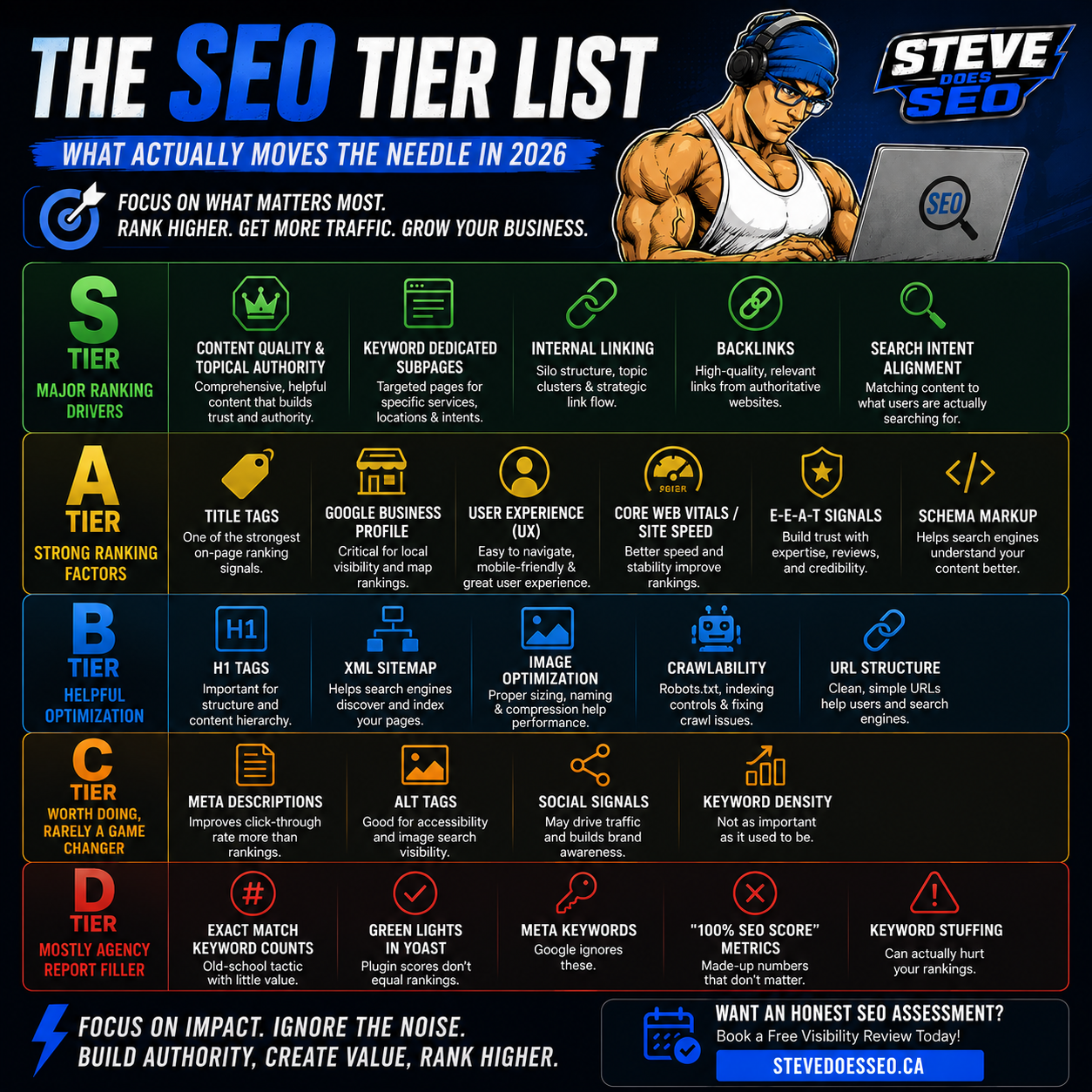
If I were building a website from scratch today, here’s how I would rank the most important SEO factors in 2026.
S Tier: The Major Ranking Drivers
These are the factors that move the needle the most.
If you’re limited on time or budget, this is where your focus should be.
Content Quality & Topical Authority
Google and AI search engines want to recommend the best answers.
The websites that consistently rank well are often those that thoroughly cover a topic rather than simply creating one page and hoping for the best.
For example, an HVAC company shouldn’t just have a “Heat Pump Services” page.
They should have supporting content covering:
- Heat pump repairs
- Heat pump installation
- Heat pump maintenance
- Heat pump costs
- Heat pump rebates
This creates topical authority.
Keyword-Dedicated Subpages
One of the most common SEO mistakes I see is trying to rank a single page for dozens of different keywords.
Instead, create dedicated pages for specific services and search intents.
Examples:
- Barrie Fence Installation
- Orillia Fence Repair
- Muskoka Duct Cleaning
- Estate Planning Lawyer Barrie
The more closely a page matches what someone is searching for, the better its chances of ranking.
Internal Linking
Internal linking is one of the most underutilized SEO strategies.
A strong internal linking structure helps:
- Distribute authority across your website
- Help Google understand relationships between pages
- Improve user navigation
- Strengthen content silos
Many websites focus heavily on backlinks while ignoring internal links entirely.
Backlinks
Backlinks remain one of Google’s strongest authority signals.
When reputable websites link to your content, it acts as a vote of confidence.
Quality matters far more than quantity.
One relevant industry backlink can be worth more than dozens of low-quality directory links.
Search Intent Alignment
A page can be perfectly optimized and still fail if it doesn’t match what users actually want.
Understanding search intent is often the difference between ranking and not ranking.
A Tier: Strong Ranking Factors
These aren’t usually enough to rank a page by themselves, but they can significantly improve performance.
Title Tags
Your title tag remains one of the strongest on-page SEO signals.
It’s often the first thing both Google and users see.
Google Business Profile
For local businesses, your Google Business Profile can be just as important as your website.
User Experience (UX)
If visitors struggle to navigate your website, rankings and conversions will suffer.
Core Web Vitals & Site Speed
A fast website creates a better user experience and removes technical barriers.
E-E-A-T Signals
Experience, Expertise, Authority, and Trustworthiness continue to play a growing role.
Schema Markup
Schema helps search engines better understand your content and can improve visibility through enhanced search results.
B Tier: Helpful Optimizations
These are worthwhile, but they aren’t usually the reason one website outranks another.
H1 Tags
Important for page structure and content hierarchy.
XML Sitemap
Helps search engines discover and index pages.
Image Optimization
Proper file sizes and image compression improve performance.
Crawlability
Search engines need to be able to access your content efficiently.
URL Structure
Clean URLs improve usability and help search engines understand page topics.
C Tier: Worth Doing, Rarely a Game Changer
These factors have value but are often overemphasized.
Meta Descriptions
Meta descriptions can improve click-through rates but have very little direct impact on rankings.
Alt Tags
Important for accessibility and image search but not a major ranking factor for most websites.
Social Signals
Social media can help generate awareness, but likes and shares don’t directly improve rankings.
Keyword Density
This mattered much more a decade ago than it does today.
D Tier: Mostly SEO Report Filler
These are the items that often appear in reports because they’re easy to measure—not because they significantly impact rankings.
Exact Match Keyword Counts
Google is far more sophisticated than simple keyword counting.
Green Lights in SEO Plugins
A page with a perfect Yoast score can still rank poorly.
A page with a mediocre score can still rank #1.
Meta Keywords
Google has ignored meta keywords for years.
“100% SEO Score” Metrics
Many SEO tools generate scores that have little relationship to actual rankings.
Keyword Stuffing
This doesn’t help rankings.
In many cases, it can hurt them.
Why Most Businesses Focus on the Wrong Things
Many business owners spend hours worrying about alt tags and meta descriptions while ignoring content strategy, internal linking, and service page development.
That’s backwards.
If your website has:
- Poor content
- Weak service pages
- No topical authority
- Minimal internal linking
Then fixing alt tags isn’t going to move the needle.
Focus on the activities that create the greatest impact first.
Final Thoughts
SEO isn’t about checking boxes.
It’s about understanding which activities produce meaningful results.
The highest-performing websites aren’t winning because they have perfect meta descriptions.
They’re winning because they’ve built authority, created valuable content, organized their websites effectively, and earned trust from both users and search engines.
If you’re trying to improve your rankings, start with the S Tier factors first.
Everything else becomes much easier after that.
Want to Know What’s Holding Your Website Back?
Book a Free Visibility Review and I’ll show you:
- Which SEO factors are helping your website
- Which areas need improvement
- Where your competitors have an advantage
- What actions are most likely to improve rankings
Because not all SEO work is created equal.